Sociology: Theories, Identity & Health
Free MCAT study guide — Psychological, Social, and Biological Foundations of Behavior
Sociological Theories
| Theory | Key Thinker | Focus | Level |
|---|---|---|---|
| Functionalism | Durkheim | Society as interdependent parts; stability | Macro |
| Conflict theory | Marx | Power, inequality, class struggle | Macro |
| Symbolic interactionism | Mead, Blumer | Meaning through symbols, interaction | Micro |
| Feminist theory | Various | Gender inequality, patriarchy | Macro/Micro |
| Social constructionism | Berger, Luckmann | Reality is socially constructed | Micro |
Social Stratification
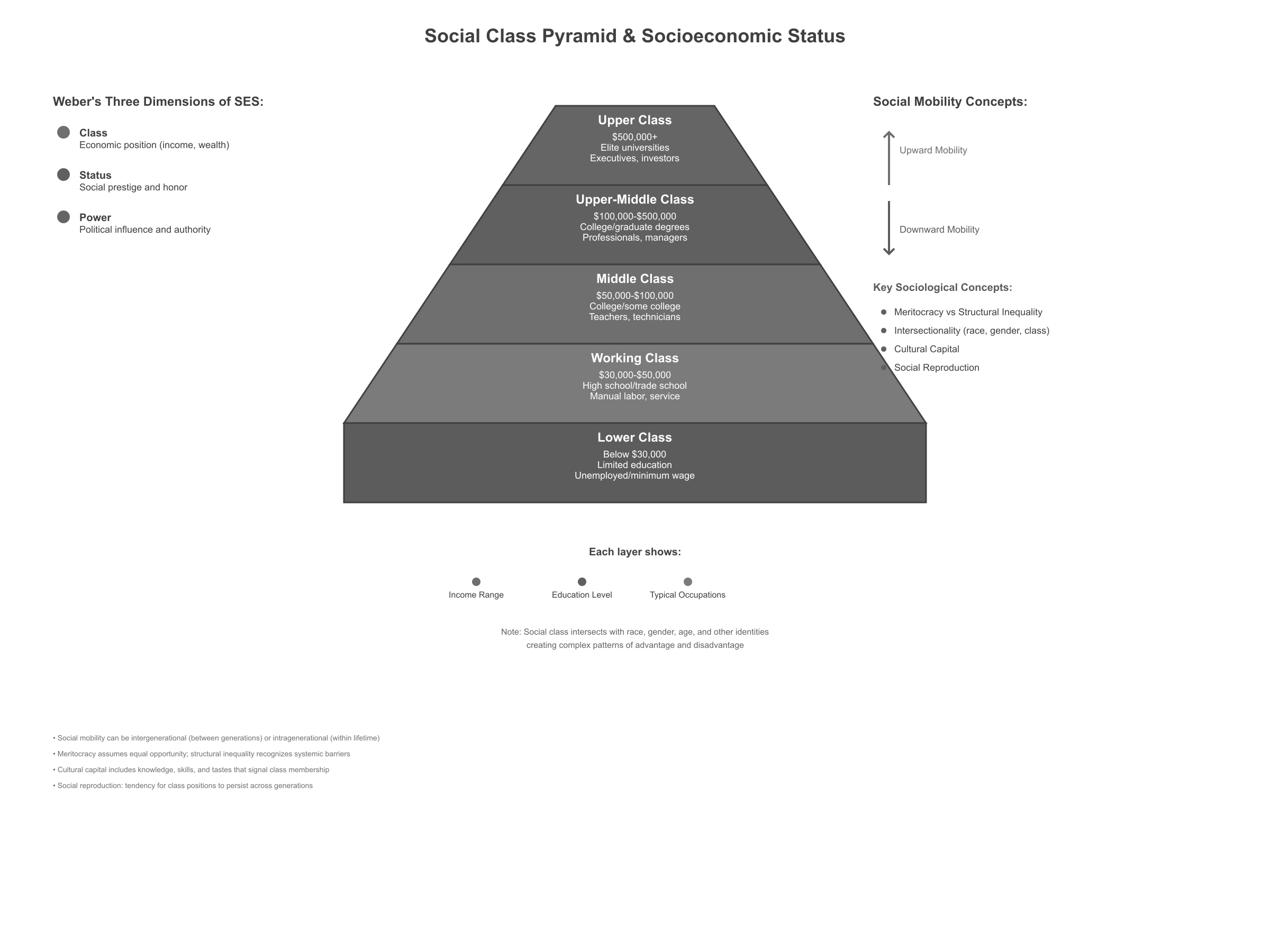
Key Point: Weber: 3 dimensions — Class (economic), Status (prestige), Party (political power). Marx: bourgeoisie vs proletariat.
Social Psychology
| Concept | Definition |
|---|---|
| Fundamental attribution error | Overattribute others' behavior to disposition, underattribute to situation |
| Self-serving bias | Attribute success to self, failure to external factors |
| Cognitive dissonance | Discomfort when attitudes ≠ behavior → change attitude |
| Conformity | Adjust behavior to group norms (Asch line experiment) |
| Obedience | Follow authority (Milgram shock experiment) |
| Bystander effect | More bystanders → less likely to help (diffusion of responsibility) |
| In-group bias | Favor own group members over out-group |
| Stereotype threat | Anxiety from confirming negative stereotype → poorer performance |
Health & Illness
Key Point: Social determinants of health: SES, education, neighborhood, access to healthcare, social support, discrimination.
Sick role (Parsons): Patient is exempt from duties but must seek help and try to recover.
Related Psychological, Social, and Biological Foundations of Behavior Study Guides
Biological Basis of Behavior: Brain Structure and NeurotransmittersHealth Disparities and Social Determinants of HealthLearning and MemoryPsychology: Learning, Memory & DevelopmentPsychology: Neuroscience & SensationSensation, Perception, and Consciousness
Browse all free MCAT study guides or read MCAT strategy on the DoctorMCAT blog.
Practice What You've Learned
Test your understanding with our question bank and practice tests.
Start Practicing Free