General Chemistry: Bonding & Intermolecular Forces
Free MCAT study guide — Chemical and Physical Foundations of Biological Systems
Illustrated Guide& PDF
Full-color, printable companion to this guide — view online or download.
Gen Chem Visual Guide View Illustrated Guide
Chemical Bonding
Bond Types
- Ionic: Transfer of electrons (ΔEN > 1.7). Metals + nonmetals. High melting point, conduct when dissolved.
- Covalent: Sharing of electrons (ΔEN < 1.7). Nonmetals. Polar if ΔEN > 0.5.
- Metallic: "Sea of electrons." Conducts electricity, malleable, ductile.
VSEPR and Molecular Geometry
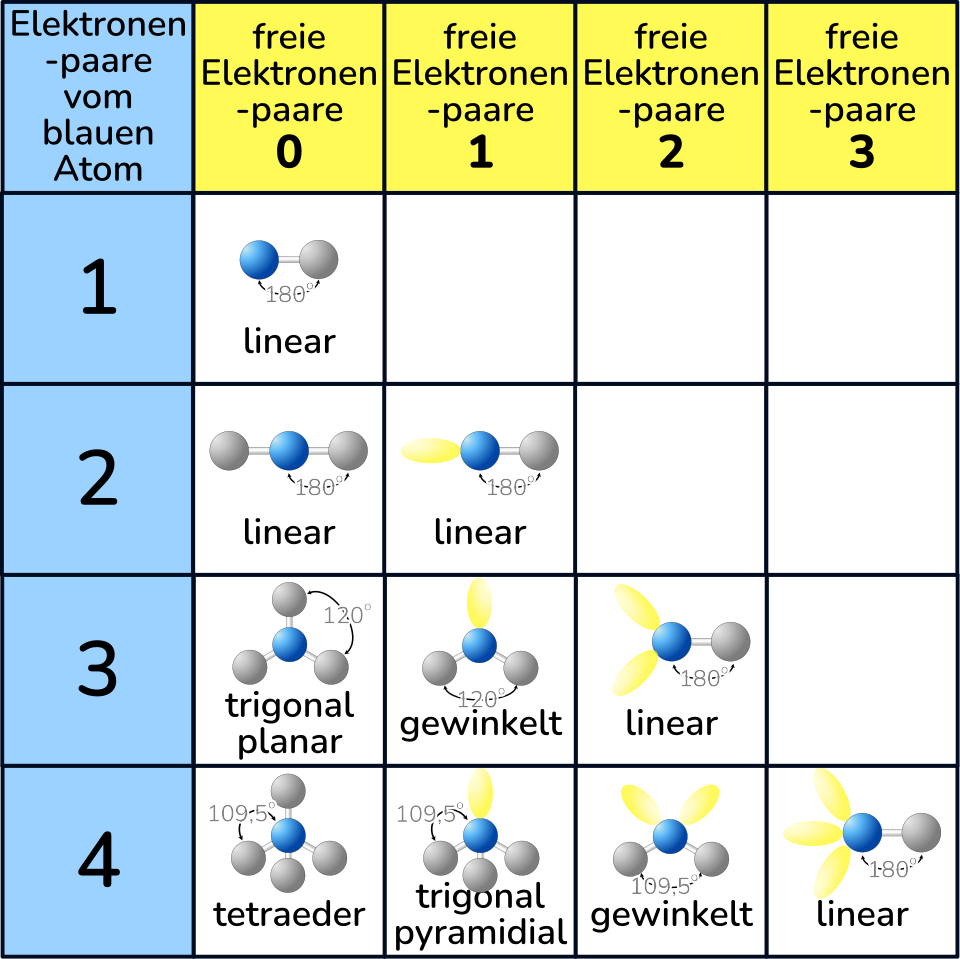
Key Point: Lone pairs compress bond angles. H₂O: 104.5° (not 109.5°), NH₃: 107° (not 109.5°).
Intermolecular Forces
| IMF Type | Strength | Requirement | Example |
|---|---|---|---|
| London dispersion | Weakest | All molecules | He, CH₄ |
| Dipole-dipole | Moderate | Polar molecules | HCl, acetone |
| Hydrogen bonding | Strong | H bonded to F, O, N | H₂O, NH₃, HF |
| Ion-dipole | Strongest | Ions + polar molecules | NaCl in H₂O |
Key Point: IMFs determine boiling point, melting point, viscosity, and surface tension. Stronger IMFs = higher BP.
London forces ∝ polarizability ∝ molecular size and electron count
Related Chemical and Physical Foundations of Biological Systems Study Guides
Acid-Base Chemistry and Buffer SystemsAtomic Structure and Periodic TrendsChemical Bonding and Molecular GeometryElectricity and Magnetism: Coulomb's Law to CircuitsElectrochemistry: Galvanic and Electrolytic CellsFluids and Circulation: Bernoulli, Poiseuille, and Blood Flow
Browse all free MCAT study guides or read MCAT strategy on the DoctorMCAT blog.
Practice What You've Learned
Test your understanding with our question bank and practice tests.
Start Practicing Free