MCAT Doctor
General Chemistry
for the MCAT
Everything you need to know for the chemistry portion of the C/P section — atomic structure, bonding, reactions, kinetics, equilibrium, thermochemistry, gases, acids & bases, electrochemistry, and solutions.
Atomic Structure
Orbitals, quantum numbers, electron config
Bonding & IMFs
Ionic, covalent, geometry, dipoles
Reactions & Stoich
Reaction types, balancing, limiting reagent
Kinetics
Rate laws, orders, Michaelis-Menten
Equilibrium
Keq, Q, Le Chatelier's principle
Thermo & Gases
Enthalpy, entropy, Gibbs, ideal gas law
Acids & Bases
pH, buffers, titrations, Henderson-Hasselbalch
Electrochemistry
Redox, galvanic, electrolytic cells
Solutions
Solubility, Ksp, colligative properties
General Chemistry — Atomic Structure
1
Atomic Structure
The atom, electron configuration, and quantum numbers
The Atom
⚙ Reading the Periodic Table
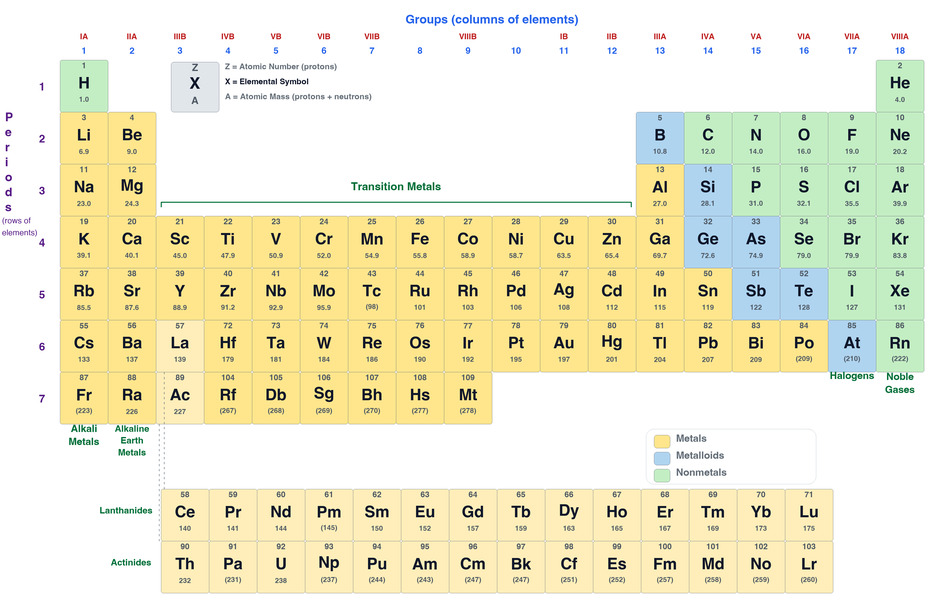
Atomic number (Z) = number of protons (defines the element)
Mass number (A) = protons + neutrons
Isotopes = same Z, different number of neutrons
Moles = mass of sample / molar mass
Avogadro's number: NA = 6.022 × 10²³
☉ Bohr Model & Quantum Theory
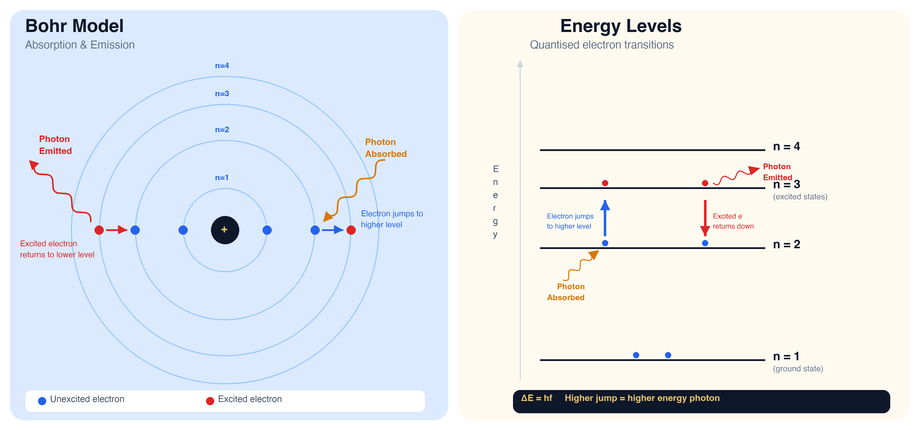
Electrons orbit the nucleus in quantised energy levels. Farther orbits = higher energy.
Emission: electron drops to lower level → emits a photon (E = hf)
Absorption: photon promotes electron to higher level
Planck: energy comes in discrete quanta
Heisenberg: cannot simultaneously know exact position and momentum
✔ Key Rules
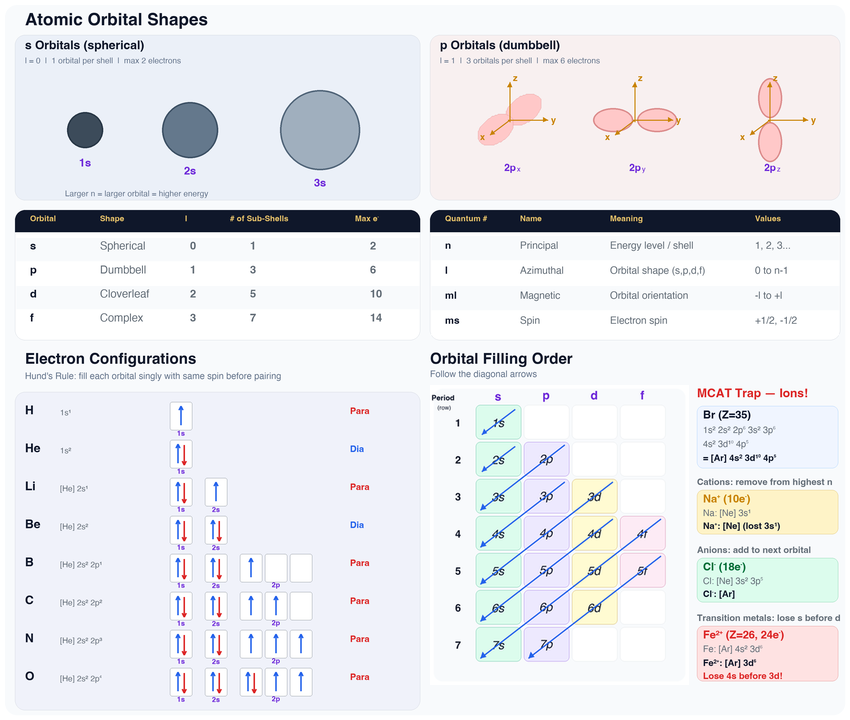
Max electrons per shell: 2n²
Max electrons per subshell: 4l + 2
Aufbau: fill lowest energy orbitals first
Pauli exclusion: no two electrons share all 4 quantum numbers
Hund's rule: fill each orbital in a subshell singly before pairing
↑ Orbital Filling Order
1s → 2s → 2p → 3s → 3p → 4s → 3d → 4p → 5s → 4d → 5p → 6s → 4f → 5d → 6p → 7s → 5f → 6d
Diamagnetic: all electrons paired (not attracted to magnetic field)
Paramagnetic: ≥1 unpaired electron (attracted to magnetic field)
General Chemistry — Periodic Trends
2
Periodic Trends
How properties change across and down the periodic table
| Property | Across a Period (→) | Down a Group (↓) | Why |
|---|
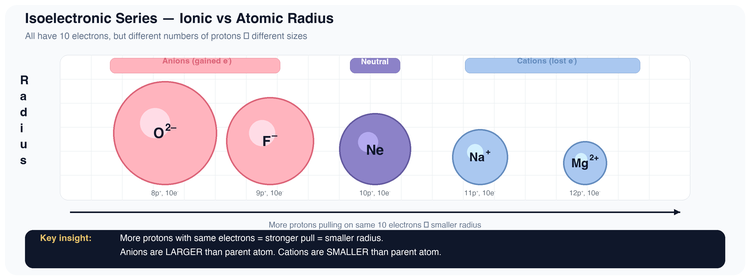
| Atomic radius | Decreases | Increases | More protons pull electrons in; more shells push radius out |
| Ionisation energy | Increases | Decreases | Harder to remove electron when nuclear charge is higher |
| Electron affinity | Increases (more –) | Decreases | Atoms closer to full octet want electrons more |
| Electronegativity | Increases | Decreases | Stronger pull on shared electrons |
| Metallic character | Decreases | Increases | Metals lose electrons easily; easier when IE is low |
⚠
MCAT favourite Effective nuclear charge (Zeff) increases across a period because each added proton is only partially shielded by electrons in the same shell. This single concept explains most periodic trends.
General Chemistry — Bonding & Intermolecular Forces
3
Chemical Bonding
How atoms connect — ionic, covalent, coordinate, and metallic bonds
⊞ Ionic Bonds
Transfer of electrons between metal and nonmetal → cation + anion.
Form crystalline lattices with high melting points.
Conduct electricity when dissolved or molten.
≡ Covalent Bonds
Sharing of electrons, typically between nonmetals.
Coordinate covalent: one atom donates both electrons (Lewis acid-base).
Formal charge = valence e⁻ – lone pair e⁻ – bonds
| Bond Type | Bond Order | σ / π | Strength | Length | Hybridisation | Angles |
|---|
| Single (σ) | 1 | 1σ, 0π | Lowest | Longest | sp³ | 109.5° |
| Double (σ + π) | 2 | 1σ, 1π | Medium | Medium | sp² | 120° |
| Triple (σ + 2π) | 3 | 1σ, 2π | Highest | Shortest | sp | 180° |
VSEPR Geometry
| Bonding Domains | Lone Pairs | Geometry | Example |
|---|
| 2 | 0 | Linear (180°) | CO₂ |
| 3 | 0 | Trigonal planar (120°) | BF₃ |
| 2 | 1 | Bent (~118°) | SO₂ |
| 4 | 0 | Tetrahedral (109.5°) | CH₄ |
| 3 | 1 | Trigonal pyramidal (~107°) | NH₃ |
| 2 | 2 | Bent (~104.5°) | H₂O |
| 5 | 0 | Trigonal bipyramidal | PCl₅ |
| 6 | 0 | Octahedral (90°) | SF₆ |
4
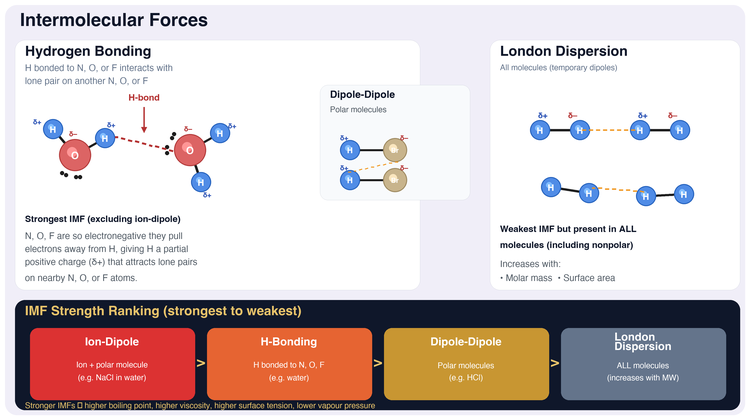
Intermolecular Forces (between Different Molecules)
Forces between molecules — determine boiling point, solubility, and phase
| IMF Type | Strength | Description |
|---|
| Ion–dipole | Strongest | Ion interacts with polar molecule (e.g., NaCl dissolving in water) |
| Hydrogen bonding | Strong | H bonded to N, O, or F interacts with lone pair on another N, O, or F |
| Dipole–dipole | Moderate | Attraction between partial charges on polar molecules |
| London dispersion | Weakest | Temporary dipoles from electron fluctuations. Present in ALL molecules. Increases with molar mass and surface area. |
General Chemistry — Reactions & Stoichiometry
5
Types of Reactions
Know these reaction types cold — they appear in passages constantly
Combustion
Hydrocarbon + O₂ → CO₂ + H₂O
Always exothermic. ΔH < 0.
Combination (Synthesis)
A + B → AB
Two or more reactants form one product.
Decomposition
AB → A + B
One compound breaks into simpler substances.
Single Displacement
A + BC → AC + B
More reactive element replaces a less reactive one.
Double Displacement (Metathesis)
AB + CD → AD + CB
Cations swap partners. Includes precipitation and neutralisation.
Neutralisation
Acid + Base → Salt + H₂O
Special case of double displacement.
Stoichiometry Essentials
Mole Calculations
Moles = mass (g) / molar mass (g/mol)
Moles = particles / NA
Moles of gas at STP = volume / 22.4 L
Molarity (M) = moles solute / litres solution
Limiting Reagent & Yield
The limiting reagent is the reactant that runs out first — it determines the maximum product formed.
Theoretical yield = max product from stoichiometry
% yield = (actual / theoretical) × 100
Empirical vs. molecular formula: Empirical = simplest whole-number ratio (e.g., CH₂O). Molecular = actual number of atoms (e.g., C₆H₁₂O₆). Molecular formula is always a whole-number multiple of the empirical formula.
6
Solubility & Solutions
Ksp, common ion effect, and colligative properties
Solubility Product (Ksp)
For AaBb(s) ⇌ aA+ + bB–:
Ksp = [A]a[B]b
Higher Ksp = more soluble. If Q > Ksp, precipitate forms.
Common Ion Effect
Adding an ion already present in solution shifts equilibrium left → decreases solubility.
E.g., adding NaCl to a solution of AgCl decreases AgCl solubility.
Osmotic Pressure
Π = iMRT
i = van't Hoff factor (# particles upon dissolution)
NaCl → i = 2; CaCl₂ → i = 3; glucose → i = 1
Colligative Properties
Depend on number of solute particles, not identity:
• Boiling point elevation: ΔTb = iKbm
• Freezing point depression: ΔTf = iKfm
• Vapour pressure lowering (Raoult's law)
General Chemistry — Chemical Kinetics
7
Chemical Kinetics
How fast reactions go — rate laws, reaction orders, and catalysis
Rate = change in concentration per unit time. For aA + bB → cC + dD:
Rate = k[A]x[B]y
k = rate constant, x and y = reaction orders (determined experimentally, not from coefficients).
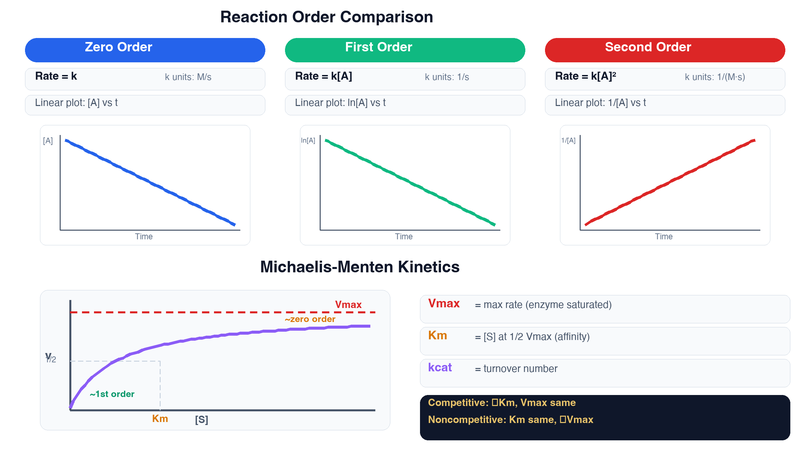
| Property | Zero Order | First Order | Second Order |
|---|
| Rate law | Rate = k | Rate = k[A] | Rate = k[A]² |
| Integrated rate law | [A] = [A]₀ – kt | ln[A] = ln[A]₀ – kt | 1/[A] = 1/[A]₀ + kt |
| Linear plot | [A] vs t | ln[A] vs t | 1/[A] vs t |
| Half-life | t½ = [A]₀ / 2k | t½ = 0.693 / k | t½ = 1 / k[A]₀ |
| Units of k | M/s | s⁻¹ | M⁻¹s⁻¹ |
Determining order experimentally: If doubling [A] has no effect on rate → zero order. If rate doubles → first order. If rate quadruples → second order.
Factors Affecting Rate
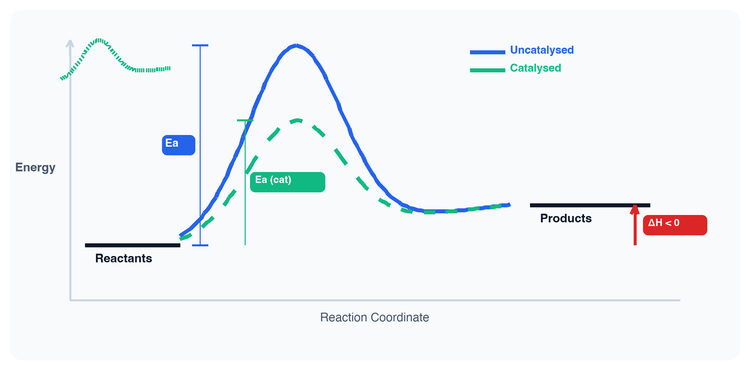
- Temperature ↑ → rate ↑ (molecules have more KE, more collisions exceed Ea)
- Concentration ↑ → rate ↑ (more frequent collisions)
- Catalyst → lowers activation energy (Ea) without being consumed
- Surface area ↑ → rate ↑ (more contact between reactants)
Arrhenius Equation
k = Ae–Ea/RT
A = frequency factor (how often molecules collide correctly), Ea = activation energy, R = 8.314 J/(mol·K). You won't calculate with this, but know: ↑ T or ↓ Ea → ↑ k → faster reaction.
Enzyme Kinetics (Michaelis-Menten)
Key Parameters
v = Vmax[S] / (Km + [S])
Vmax = maximum rate (enzyme saturated)
Km = [S] at which v = ½Vmax
Low Km = high affinity for substrate
kcat = turnover number (reactions per enzyme per second)
Key Concepts
At low [S]: reaction is ~first order (rate depends on [S])
At high [S]: reaction is ~zero order (enzyme saturated, rate = Vmax)
Competitive inhibitor: ↑ Km, Vmax unchanged
Uncompetitive inhibitor: ↓ Km, ↓ Vmax
Noncompetitive inhibitor: Km unchanged, ↓ Vmax
General Chemistry — Equilibrium
8
Chemical Equilibrium
Keq, reaction quotient Q, and Le Chatelier's principle
For aA + bB ⇌ cC + dD at equilibrium:
Keq = [C]c[D]d / [A]a[B]b
Ratio of products to reactants at equilibrium — only includes aqueous and gaseous species
| Condition | Meaning | ΔG |
|---|
| Keq >> 1 | Products favoured at equilibrium | ΔG° < 0 |
| Keq = 1 | Products ≈ reactants at equilibrium | ΔG° = 0 |
| Keq << 1 | Reactants favoured at equilibrium | ΔG° > 0 |
Reaction Quotient (Q) vs K
| Comparison | Direction | What Happens |
|---|
| Q < K | Shifts right (→) | More products need to form to reach equilibrium |
| Q = K | At equilibrium | No net change |
| Q > K | Shifts left (←) | More reactants need to form to reach equilibrium |
Le Chatelier's Principle
If a stress is applied to a system at equilibrium, the system shifts to relieve that stress.
| Stress | Shift Direction | Example |
|---|
| Add reactant | Right → | Adding A or B pushes toward products |
| Remove product | Right → | Removing C shifts forward to replace it |
| Add product | Left ← | Adding C pushes back toward reactants |
| ↑ Pressure / ↓ Volume | Toward fewer moles of gas | If 4 mol gas → 2 mol gas, shifts right |
| ↓ Pressure / ↑ Volume | Toward more moles of gas | Opposite of above |
| ↑ Temperature (exo rxn) | Left ← | Heat is a "product" — adding it shifts left |
| ↑ Temperature (endo rxn) | Right → | Heat is a "reactant" — adding it shifts right |
| Catalyst added | No shift | Reaches equilibrium faster but K unchanged |
❤
Bicarbonate Buffer (MCAT classic)CO₂ + H₂O ⇌ H₂CO₃ ⇌ H⁺ + HCO₃⁻
↑ CO₂ (hypoventilation) → shifts right → ↑ H⁺ → ↓ pH (respiratory acidosis)
↓ CO₂ (hyperventilation) → shifts left → ↓ H⁺ → ↑ pH (respiratory alkalosis)
Kinetic vs. thermodynamic products: Kinetic products form faster (lower Ea) and are favoured at low temperature. Thermodynamic products are more stable (lower ΔG) and are favoured at high temperature and longer reaction times.
General Chemistry — Thermochemistry
9
Thermochemistry & Thermodynamics
Energy, enthalpy, entropy, and Gibbs free energy
Systems & Surroundings
Open System
Exchanges both energy and matter with surroundings.
Closed System
Exchanges energy only. No matter enters or leaves.
Isolated System
No exchange of energy or matter (ideal — the universe).
Heat & Phase Changes
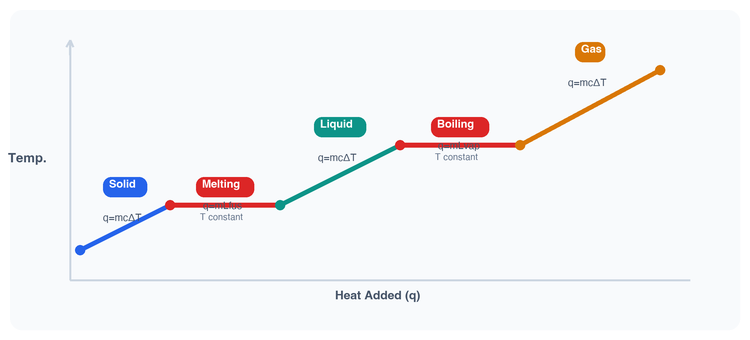
Temperature Change (no phase change)
q = mcΔT
m = mass, c = specific heat, ΔT = temperature change
Specific heat of water: 4.184 J/(g·K)
Phase Change (no temperature change)
q = mL
L = latent heat (Lfus for melting, Lvap for boiling)
Temperature stays constant during phase transition
Enthalpy (H), Entropy (S), and Gibbs Free Energy (G)
Enthalpy (ΔH)
Heat absorbed or released at constant pressure.
Exothermic: ΔH < 0 (releases heat)
Endothermic: ΔH > 0 (absorbs heat)
Hess's Law: ΔH is additive — the enthalpy change of a reaction is the same regardless of path.
From formations: ΔH°rxn = ΣΔH°f(products) – ΣΔH°f(reactants)
From bond energies: ΔH°rxn = Σ(bonds broken) – Σ(bonds formed)
Entropy (ΔS) & Gibbs (ΔG)
Entropy: measure of disorder/energy dispersal.
ΔS°rxn = ΣS°(products) – ΣS°(reactants)
S increases: solid → liquid → gas, fewer → more moles of gas
ΔG = ΔH – TΔS
ΔG < 0: spontaneous (forward)
ΔG = 0: at equilibrium
ΔG > 0: non-spontaneous (reverse favoured)
| ΔH | ΔS | –TΔS | ΔG | Spontaneity |
|---|
| – (exo) | + (↑ disorder) | – | Always – | Spontaneous at all T |
| + (endo) | – (↓ disorder) | + | Always + | Non-spontaneous at all T |
| – (exo) | – (↓ disorder) | + | Depends on T | Spontaneous at LOW T |
| + (endo) | + (↑ disorder) | – | Depends on T | Spontaneous at HIGH T |
🔗
Key relationshipΔG° = –RT ln K links thermodynamics to equilibrium. If ΔG° < 0 → K > 1 (products favoured). Also: ΔG° = –nFE°cell links to electrochemistry.
General Chemistry — Gas Phase
10
Gas Laws & Kinetic Molecular Theory
Ideal gas law, Dalton's law, and real vs. ideal gases
PV = nRT
The Ideal Gas Law — relates pressure, volume, moles, and temperature
R = 8.314 J/(mol·K) or 0.0821 L·atm/(mol·K). T must be in Kelvin. At STP (273 K, 1 atm), 1 mol of any ideal gas = 22.4 L.
| Law | Relationship | Constant | Equation |
|---|
| Boyle's | P ∝ 1/V | T, n | P₁V₁ = P₂V₂ |
| Charles's | V ∝ T | P, n | V₁/T₁ = V₂/T₂ |
| Gay-Lussac's | P ∝ T | V, n | P₁/T₁ = P₂/T₂ |
| Avogadro's | V ∝ n | P, T | V₁/n₁ = V₂/n₂ |
| Combined | All three | n | P₁V₁/T₁ = P₂V₂/T₂ |
Dalton's Law of Partial Pressures
Ptotal = P₁ + P₂ + P₃ + … and PA = χA × Ptotal
Each gas in a mixture contributes to total pressure in proportion to its mole fraction (χ).
Kinetic Molecular Theory
- Gas particles are in constant, random motion with elastic collisions
- No intermolecular forces between ideal gas particles
- Gas particles have negligible volume compared to the container
- Average KE depends only on temperature: KEavg = (3/2)kBT
- At a given T, lighter gases move faster (higher vrms)
Graham's Law
r₁/r₂ = √(M₂/M₁)
Lighter gases diffuse/effuse faster.
Diffusion: spreading of gas through space
Effusion: gas escaping through a small hole
Real Gases
Deviate from ideal at high pressure (volume matters) and low temperature (IMFs matter).
Most ideal at: high T, low P.
Henry's Law: amount of gas dissolved in liquid ∝ partial pressure of that gas above the liquid.
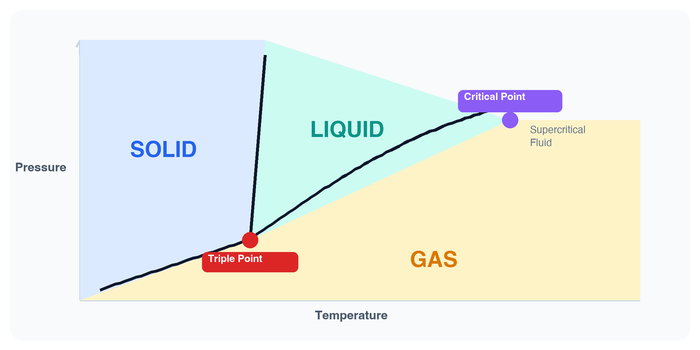
Diatomic elements (HONClBrIF): H₂, O₂, N₂, Cl₂, Br₂, I₂, F₂. These exist as diatomic molecules in their standard state — important for stoichiometry and gas law calculations.
General Chemistry — Acids & Bases
11
Acids & Bases
Definitions, pH calculations, buffers, and titrations — very high yield
Definitions
| Definition | Acid | Base |
|---|
| Brønsted-Lowry | Proton (H⁺) donor | Proton (H⁺) acceptor |
| Lewis | Electron pair acceptor | Electron pair donor |
pH Scale & Key Equations
pH / pOH
pH = –log[H⁺] pOH = –log[OH⁻]
pH + pOH = 14 (at 25°C)
Kw = Ka × Kb = 1.0 × 10⁻¹⁴
Neutral: [H⁺] = [OH⁻] → pH = 7
Acidic: [H⁺] > [OH⁻] → pH < 7
Basic: [H⁺] < [OH⁻] → pH > 7
Ka and Kb
Ka = [H⁺][A⁻] / [HA]
Kb = [BH⁺][OH⁻] / [B]
pKa = –log(Ka)
Stronger acid → larger Ka → smaller pKa → weaker conjugate base
Stronger base → larger Kb → smaller pKb → weaker conjugate acid
Strong Acids & Bases (Memorise These)
6 Strong Acids
HCl, HBr, HI, HNO₃, H₂SO₄, HClO₄
Dissociate completely → [H⁺] = [acid]
6 Strong Bases
LiOH, NaOH, KOH, Ca(OH)₂, Sr(OH)₂, Ba(OH)₂
Dissociate completely → [OH⁻] = [base] (×2 for Group 2)
Buffers & Henderson-Hasselbalch
A buffer resists pH changes and consists of a weak acid + its conjugate base (or weak base + conjugate acid). Most effective when pH ≈ pKa (±1).
pH = pKa + log([A⁻] / [HA])
Henderson-Hasselbalch — the single most important acid-base equation on the MCAT
At the half-equivalence point of a titration: [A⁻] = [HA], so log(1) = 0, and pH = pKa.
Titration Curves
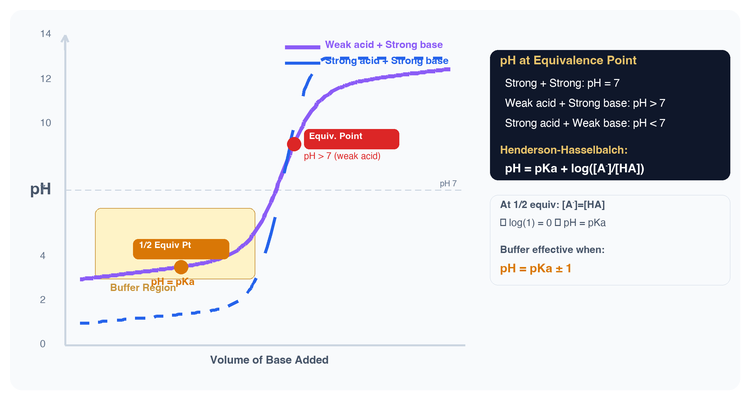
| Titration Type | pH at Equivalence | Why |
|---|
| Strong acid + Strong base | pH = 7 | Conjugate salt is neutral |
| Weak acid + Strong base | pH > 7 | Conjugate base of weak acid is basic |
| Strong acid + Weak base | pH < 7 | Conjugate acid of weak base is acidic |
Indicators: Weak acids/bases that change colour at specific pH ranges. The indicator's pKa should be close to the equivalence point pH. Endpoint ≠ equivalence point (endpoint is when the indicator changes colour).
General Chemistry — Electrochemistry
12
Electrochemistry
Redox reactions, galvanic cells, electrolytic cells, and reduction potentials
Oxidation & Reduction
⚡ OIL RIG / LEO GER
Oxidation = loss of electrons (↑ oxidation state)
Reduction = gain of electrons (↓ oxidation state)
Oxidising agent: causes oxidation of another species; is itself reduced
Reducing agent: causes reduction of another species; is itself oxidised
№ Oxidation State Rules
Free element: 0
Group 1 metals: +1; Group 2: +2
Hydrogen: +1 (except metal hydrides: –1)
Fluorine: always –1
Oxygen: –2 (except peroxides: –1)
Sum of oxidation states = charge of species
Galvanic vs. Electrolytic Cells
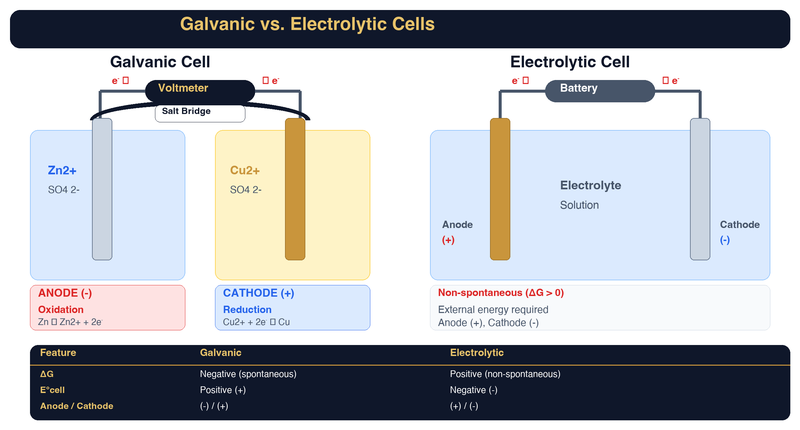
| Feature | Galvanic (Voltaic) | Electrolytic |
|---|
| Spontaneity | Spontaneous (ΔG < 0) | Non-spontaneous (requires external energy) |
| E°cell | Positive (+) | Negative (–) — forced by external voltage |
| Energy conversion | Chemical → electrical | Electrical → chemical |
| Anode sign | Negative (–) | Positive (+) |
| Cathode sign | Positive (+) | Negative (–) |
| Anode process | Oxidation (always — "An Ox") |
| Cathode process | Reduction (always — "Red Cat") |
| Electron flow | Always anode → cathode (through external wire) |
Key Equations
Cell Potential
E°cell = E°cathode – E°anode
Use standard reduction potentials. More positive E°red → more easily reduced.
The species with the higher E°red is reduced (cathode).
Linking Thermo & Electro
ΔG° = –nFE°cell
n = moles of electrons transferred
F = Faraday's constant = 96,485 C/mol
If E°cell > 0 → ΔG° < 0 → spontaneous (galvanic)
Salt bridge: Completes the circuit by allowing ions to flow between half-cells. Anions migrate toward the anode; cations migrate toward the cathode. Without it, charge buildup would stop the reaction.
Concentration cells: Same electrodes but different concentrations. Current flows until concentrations equalise. The dilute side is the anode (oxidised), the concentrated side is the cathode (reduced).
ΔG° = –RT ln K = –nFE°cell
The Big Three — links thermodynamics, equilibrium, and electrochemistry. Know one, find the other two.