MCAT Doctor
Every Physics Equation
for the MCAT
All the physics equations you need to know for the MCAT — organised by topic and ranked by yield. Focus your study time on what actually gets tested.
★★★ Must Know
★★ High Yield
★ Know It
Mechanics
Kinematics, Forces, Work, Energy, Momentum
~25%
Fluids
Pressure, Buoyancy, Flow, Bernoulli
~20%
Electricity
Coulomb, Circuits, Capacitors
~15%
Waves & Sound
Wave eq, Doppler, Decibels
~15%
Optics
Snell's, Lenses, Mirrors
~10%
Thermo & Modern
Heat, Gas Laws, Nuclear, Photoelectric
~15%
How to use this guide: Equations marked ★★★ appear on almost every MCAT. Master these first. Then move to ★★ equations, which appear regularly. ★ equations show up occasionally — know the concept, but don't lose sleep over them.
Physics Equations — Mechanics I
1
Kinematics
Motion in 1D and 2D — constant acceleration only (no air resistance)
| Name | Equation | When to Use / Notes | Yield |
|---|
| Velocity | vf = v₀ + at | Use this equation when d is not given or asked for | ★★★ |
| Displacement | x = v₀t + ½at² | Use this equation when vf is not given or asked for | ★★★ |
| Velocity–Displacement | vf² = v₀² + 2ax | Use this equation when t is not given or asked for | ★★★ |
| Average Velocity | x = ½(vf + v₀)t | Use this equation when a is not given or asked for | ★★★ |
| Free Fall | a = g = 9.8 m/s² | Use g ≈ 10 m/s² on MCAT for fast math | ★★★ |
MCAT tip: Projectile motion splits into independent x and y components. Horizontal: constant velocity (aₓ = 0). Vertical: constant acceleration (aᵧ = –g). Time is the same for both. Components: v₀ₓ = v₀cosθ, v₀ᵧ = v₀sinθ. Max range at 45°.
2
Forces & Newton's Laws
The foundation of all MCAT mechanics — appears in virtually every C/P section
| Name | Equation | When to Use / Notes | Yield |
|---|
| Newton's 2nd Law | F = ma | Net force = mass × acceleration. The single most important equation in physics. | ★★★ |
| Weight | W = mg | Force of gravity; use g ≈ 10 m/s² | ★★★ |
| Friction | f = μN | Static (f ≤ μₛN) or kinetic (f = μₖN). N = normal force, not always mg. | ★★★ |
| Inclined Plane (∥) | F∥ = mg sinθ | Component of gravity along the slope | ★★★ |
| Inclined Plane (⊥) | N = mg cosθ | Normal force on a frictionless incline | ★★★ |
| Centripetal Force | F꜀ = mv²/r | Net inward force for circular motion; not a new force | ★★★ |
| Centripetal Accel. | a꜀ = v²/r | Always points toward center of circle | ★★ |
| Hooke's Law | F = –kx | Spring restoring force; k = spring constant, x = displacement from equilibrium | ★★★ |
| Universal Gravitation | F = Gm₁m₂/r² | Inverse-square law; G = 6.67 × 10⁻¹¹ N·m²/kg² | ★★ |
Newton's 3rd Law: Every action has an equal and opposite reaction. Forces act on different objects. The MCAT loves to test whether you know which forces form action–reaction pairs.
Free Body Diagram strategy: Draw ALL forces on the object. Choose axes aligned with motion (tilt axes on inclines). Set ΣF = ma in each direction. On inclines: ΣF∥ = ma along slope, ΣF⊥ = 0 perpendicular.
Finding Components — The Pencil Trick
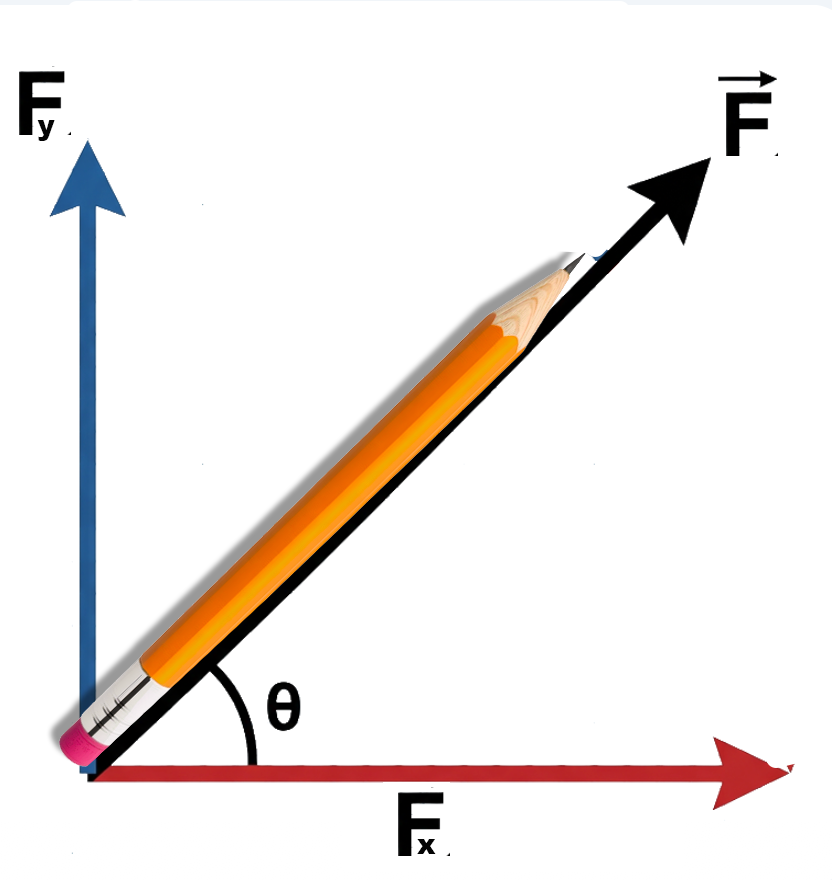
Step 1: Place pencil along F at the origin.
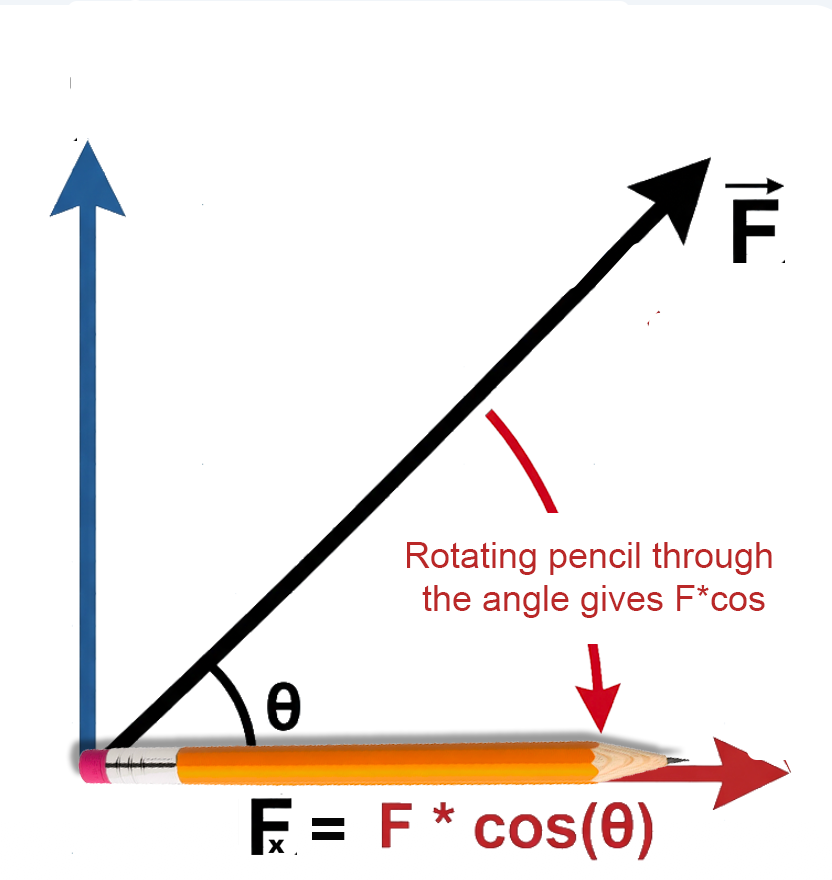
Step 2a: Rotate through θ to the x-axis → Fx = F·cos(θ)
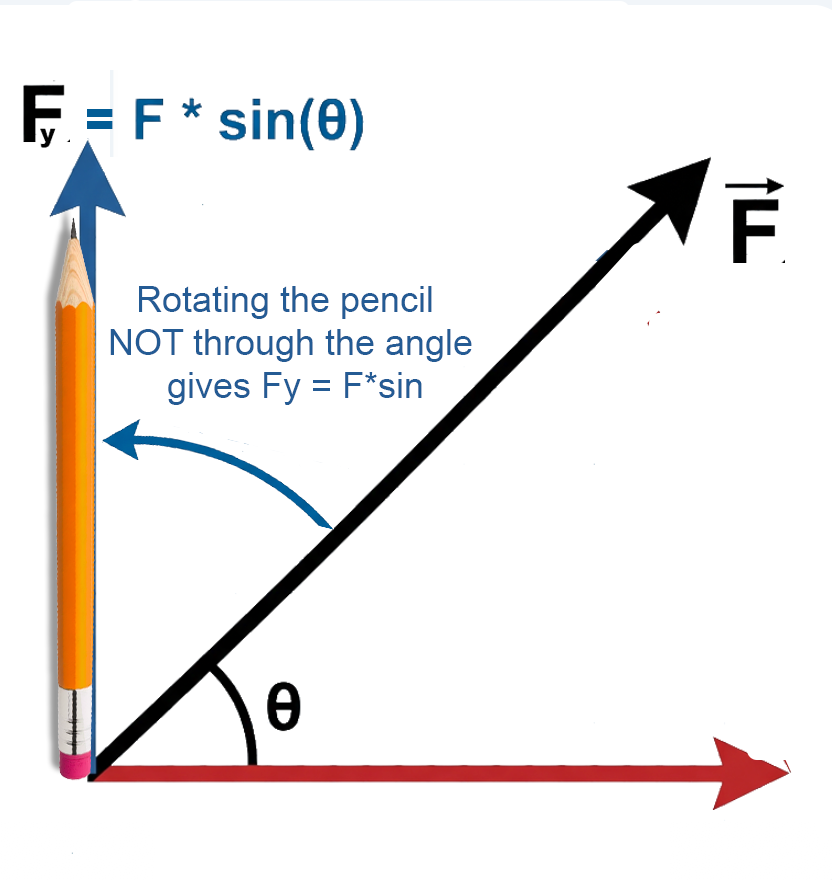
Step 2b: Rotate not through θ to the y-axis → Fy = F·sin(θ)
Works every time — inclines, projectiles, tension problems. No more guessing sin vs cos.
Physics Equations — Mechanics II
3
Work, Energy & Power
Conservation of energy is tested on nearly every MCAT — often paired with fluids or circuits
| Name | Equation | When to Use / Notes | Yield |
|---|
| Work | W = Fd cosθ | Only the force component parallel to displacement does work. θ = angle between F and d. | ★★★ |
| Kinetic Energy | KE = ½mv² | Energy of motion; always positive | ★★★ |
| Gravitational PE | PE = mgh | Relative to a chosen reference point (usually ground = 0) | ★★★ |
| Spring PE | PE = ½kx² | Energy stored in a compressed/stretched spring | ★★★ |
| Work–Energy Theorem | W_net = ΔKE | Net work done on an object = change in its KE | ★★★ |
| Conservation of Energy | KE₁ + PE₁ = KE₂ + PE₂ | When only conservative forces act (no friction) | ★★★ |
| Power | P = W/t | Rate of doing work; SI unit = watt (W) | ★★★ |
| Power (alt.) | P = Fv | Instantaneous power when force and velocity are parallel | ★★ |
| Pressure | P = F/A | Force per unit area. SI unit = Pascal (Pa) = N/m². 1 atm ≈ 10⁵ Pa. | ★★★ |
| Mechanical Advantage | MA = F_out / F_in | Simple machines; MA > 1 means force is amplified but distance is reduced | ★★ |
| Efficiency | e = W_out / W_in × 100% | Always ≤ 100%; energy lost to friction/heat | ★★ |
Conservative vs. Non-conservative: Gravity and springs are conservative (path-independent, have PE). Friction and air resistance are non-conservative (path-dependent, convert KE to heat). With friction: KE₁ + PE₁ = KE₂ + PE₂ + W_friction.
4
Momentum & Impulse
Conservation of momentum — collisions, explosions, and recoil
| Name | Equation | When to Use / Notes | Yield |
|---|
| Momentum | p = mv | Vector quantity; has direction. SI unit = kg·m/s | ★★ |
| Impulse | J = FΔt = Δp | Impulse = change in momentum. Airbags increase Δt → decrease F. | ★★ |
| Conservation of Momentum | m₁v₁ + m₂v₂ = m₁v₁' + m₂v₂' | Always conserved in collisions (no external forces) | ★★ |
| Perfectly Inelastic | m₁v₁ + m₂v₂ = (m₁+m₂)v' | Objects stick together; max KE lost | ★ |
| Elastic Collision | KE conserved too | Both momentum AND KE conserved; objects bounce apart | ★ |
5
Torque & Equilibrium
Levers, seesaws, and rotational balance
| Name | Equation | When to Use / Notes | Yield |
|---|
| Torque | τ = rF sinθ | r = lever arm distance; θ = angle between r and F. SI unit = N·m | ★★★ |
| Torque (lever arm) | τ = r⊥ × F | r⊥ = perpendicular distance from pivot to line of force | ★★★ |
| Translational Equil. | ΣF = 0 | No net force → no acceleration (static or constant velocity) | ★★★ |
| Rotational Equil. | Στ = 0 | No net torque → no angular acceleration. Choose pivot wisely to eliminate unknowns. | ★★★ |
| Center of Mass | x_cm = Σmᵢxᵢ / Σmᵢ | Weighted average position; objects topple when cm is outside base of support | ★ |
MCAT favourite: Seesaw / lever problems. Set Στ = 0 about the pivot. Clockwise torques = counterclockwise torques → m₁r₁ = m₂r₂. The MCAT won't ask you to calculate moments of inertia, but know that I increases when mass is farther from the axis.
Physics Equations — Fluids
6
Fluids & Fluid Dynamics
Extremely high yield — fluids appear on virtually every C/P section of the MCAT
Why fluids matter: The MCAT tests fluids more than any other physics topic. Expect 2–4 questions per exam combining pressure, buoyancy, and flow. These equations are non-negotiable.
| Name | Equation | When to Use / Notes | Yield |
|---|
| Density | ρ = m/V | ρ_water = 1000 kg/m³ = 1 g/cm³. Objects float if ρ_object < ρ_fluid. | ★★★ |
| Specific Gravity | SG = ρ_substance / ρ_water | Dimensionless ratio; SG < 1 → floats in water | ★★ |
| Pressure in Fluids | P = ρgh | Pressure due to fluid column of height h. Gauge pressure (above atmospheric). | ★★★ |
| Absolute Pressure | P_abs = P_atm + ρgh | Total pressure = atmospheric + gauge. Open containers start at P_atm. | ★★★ |
| Pascal's Law | F₁/A₁ = F₂/A₂ | Hydraulic systems: pressure transmitted equally. Small force on small area → large force on large area. | ★★★ |
| Archimedes' Principle | F_b = ρ_fluid · V_disp · g | Buoyant force = weight of displaced fluid. Object floats when F_b = W. | ★★★ |
| Fraction Submerged | V_sub/V_total = ρ_obj/ρ_fluid | For floating objects only. E.g., ice: 917/1000 ≈ 92% submerged. | ★★ |
| Continuity Equation | A₁v₁ = A₂v₂ | Conservation of mass for incompressible fluids. Narrow pipe → faster flow. | ★★★ |
| Bernoulli's Equation | P + ½ρv² + ρgh = const | Conservation of energy for flowing fluids. Faster flow → lower pressure. | ★★★ |
| Venturi Effect | ΔP = ½ρ(v₂² – v₁²) | Derived from Bernoulli at same height. Explains airplane lift, aneurysms. | ★★ |
| Flow Rate | Q = Av | Volume per time (m³/s). Q is constant throughout a pipe (continuity). | ★★ |
| Poiseuille's Law | Q = πr⁴ΔP / (8ηL) | Viscous flow in a tube. r⁴ dependence — doubling radius → 16× flow! | ★★ |
Bernoulli's assumptions: Ideal fluid = (1) incompressible, (2) non-viscous, (3) laminar (streamline) flow, (4) steady-state. Real blood flow violates most of these, but MCAT still applies Bernoulli.
MCAT trap — Buoyancy: Buoyant force depends on ρ_fluid and V_displaced, NOT on the object's mass or density. A steel ball and a hollow ball of the same size displace the same volume → same F_b.
Clinically relevant: Blood pressure = ρgh explains why BP is measured at heart level. Aneurysms: wider vessel → slower flow (continuity) → higher pressure (Bernoulli) → vessel wall weakens further. Atherosclerosis: narrower vessel → faster flow → lower pressure at stenosis but higher resistance (Poiseuille).
Physics Equations — Electricity
7
Electrostatics
Charges, electric fields, and potential — Coulomb's law is a top-5 MCAT equation
| Name | Equation | When to Use / Notes | Yield |
|---|
| Coulomb's Law | F = kq₁q₂/r² | Force between two point charges. k = 9 × 10⁹ N·m²/C². Inverse-square law like gravity. | ★★★ |
| Electric Field | E = F/q = kQ/r² | Force per unit charge. Points away from (+), toward (–). SI unit = N/C = V/m. | ★★★ |
| Electric Potential | V = kQ/r | Scalar — no direction. Positive charge creates (+) potential. SI unit = Volt. | ★★★ |
| Potential & Field | V = Ed | For uniform field between parallel plates. E = V/d. d = plate separation. | ★★★ |
| Electric PE | PE = qV = kq₁q₂/r | Energy of a charge in a potential. Positive charges move from high to low V. | ★★★ |
| Capacitance | C = Q/V | Charge stored per volt. SI unit = Farad (F). | ★★ |
| Parallel Plate Cap. | C = ε₀A/d | ε₀ = 8.85 × 10⁻¹² F/m. Increase A or decrease d → more capacitance. | ★★ |
| Dielectric | C' = κC | Inserting dielectric (κ > 1) increases capacitance by factor κ | ★ |
| Energy in Capacitor | U = ½CV² = ½QV | Energy stored in the electric field between plates | ★★ |
8
Circuits
Ohm's law, series vs. parallel, and power — high yield every exam
| Name | Equation | When to Use / Notes | Yield |
|---|
| Ohm's Law | V = IR | Voltage = current × resistance. Most-used circuit equation. | ★★★ |
| Power | P = IV = I²R = V²/R | Energy dissipated per second. All three forms are tested. | ★★★ |
| Resistors in Series | R_eq = R₁ + R₂ + ... | Current is the same; voltage splits. Total R increases. | ★★★ |
| Resistors in Parallel | 1/R_eq = 1/R₁ + 1/R₂ + ... | Voltage is the same; current splits. Total R decreases. | ★★★ |
| Capacitors in Series | 1/C_eq = 1/C₁ + 1/C₂ + ... | Opposite of resistors! Series → smaller total C. | ★★ |
| Capacitors in Parallel | C_eq = C₁ + C₂ + ... | Opposite of resistors! Parallel → larger total C. | ★★ |
| Resistance | R = ρL/A | ρ = resistivity, L = length, A = cross-sectional area. Longer wire → more R. | ★★ |
| Current | I = Q/t | Charge per second. SI unit = Ampere (A). Conventional current flows (+) to (–). | ★★ |
| Kirchhoff's Voltage | ΣV = 0 (loop) | Voltage gains = voltage drops around any closed loop | ★★ |
| Kirchhoff's Current | ΣI_in = ΣI_out (junction) | Current in = current out at any junction (conservation of charge) | ★★ |
Series vs. Parallel cheat sheet: In series, current (I) is the same everywhere and voltage (V) splits. In parallel, voltage (V) is the same across each branch and current (I) splits. Remember: resistors and capacitors have opposite combination rules.
Physics Equations — Waves & Optics
9a
Waves & Sound
Wave equation + Doppler + decibels — consistently tested every exam
| Name | Equation | When to Use / Notes | Yield |
|---|
| Wave Equation | v = fλ | Speed = frequency × wavelength. Applies to all waves. | ★★★ |
| Period–Frequency | f = 1/T | Frequency in Hz = cycles/second; T in seconds | ★★★ |
| Speed of Sound | v ≈ 340 m/s (in air) | Faster in solids > liquids > gases. Increases with temperature. | ★★ |
| Intensity | I = P/A | Power per unit area (W/m²). For point source: I = P/(4πr²) | ★ |
| Decibel Scale | β = 10 log₁₀(I/I₀) | I₀ = 10⁻¹² W/m². Every 10× intensity = +10 dB. Every 2× intensity ≈ +3 dB. | ★★★ |
| Doppler Effect | f' = f · (v ± v_o)/(v ∓ v_s) | Top sign: moving toward. Bottom sign: moving away. Source/observer approach → higher pitch. | ★★★ |
| Doppler (simple) | Δf/f = v/c | Quick approximation when source or observer speed ≪ wave speed. v = relative speed, c = wave speed. | ★★★ |
| Beat Frequency | f_beat = |f₁ – f₂| | Pulsing sound when two close frequencies interfere | ★★ |
| Standing Wave (string) | λₙ = 2L/n | Both ends fixed. n = 1, 2, 3... (harmonics). fₙ = nf₁. | ★★ |
| Standing Wave (open pipe) | λₙ = 2L/n | Both ends open. All harmonics (n = 1, 2, 3...). | ★★ |
| Standing Wave (closed pipe) | λₙ = 4L/n | One end closed. Odd harmonics only (n = 1, 3, 5...). | ★★ |
| Pendulum Period | T = 2π√(L/g) | Independent of mass and amplitude (for small angles). Longer → slower. | ★★ |
| Spring Period | T = 2π√(m/k) | Independent of amplitude. Heavier mass or weaker spring → slower. | ★★ |
9b
Optics
Refraction, lenses, and mirrors — know Snell's law and the thin lens equation cold
| Name | Equation | When to Use / Notes | Yield |
|---|
| Index of Refraction | n = c/v | n ≥ 1 always. Higher n → slower light → more bending. c = 3 × 10⁸ m/s. | ★★★ |
| Snell's Law | n₁sinθ₁ = n₂sinθ₂ | Light bends toward normal when entering denser medium (higher n). | ★★★ |
| Critical Angle (TIR) | sinθ_c = n₂/n₁ | Total internal reflection when going from high n to low n (n₁ > n₂) | ★★ |
| Thin Lens / Mirror | 1/f = 1/dₒ + 1/dᵢ | f = focal length. Sign conventions: real image → dᵢ (+); virtual → dᵢ (–). | ★★★ |
| Magnification | m = –dᵢ/dₒ = hᵢ/hₒ | |m| > 1 = enlarged. m (+) = upright. m (–) = inverted. | ★★★ |
| Lens Power | P = 1/f | In diopters (D) when f is in meters. Converging = (+), diverging = (–). | ★★ |
Real image: di is positive. Image is inverted. Located behind the lens (opposite side from object) or in front of the mirror (same side as object). Can be projected onto a screen.
Virtual image: di is negative. Image is upright. Located in front of the lens (same side as object) or behind the mirror (opposite side from object). Cannot be projected — only seen by looking into the lens/mirror.
Converging lens/mirror: f (+). Real, inverted image when dₒ > f. Virtual, upright, enlarged image when dₒ < f (magnifying glass).
Diverging lens/mirror: f (–). Always produces virtual, upright, reduced images. Think: peephole in a door.
Physics Equations — Thermodynamics & Modern Physics
10a
Thermodynamics
Heat, temperature, gas laws, and entropy — bridges physics and chemistry on the MCAT
| Name | Equation | When to Use / Notes | Yield |
|---|
| Heat Transfer | q = mcΔT | c = specific heat capacity. Water: c = 4184 J/(kg·K). No phase change. | ★★★ |
| Phase Change | q = mL | L = latent heat (fusion or vaporisation). No temperature change during phase transition. | ★★★ |
| Ideal Gas Law | PV = nRT | R = 8.314 J/(mol·K). T must be in Kelvin. n = moles. | ★★★ |
| Combined Gas Law | P₁V₁/T₁ = P₂V₂/T₂ | Fixed amount of gas; any variable can change | ★★★ |
| Boyle's Law | P₁V₁ = P₂V₂ | Constant T: pressure and volume are inversely proportional | ★★ |
| Charles's Law | V₁/T₁ = V₂/T₂ | Constant P: volume and temperature are directly proportional | ★★ |
| KE of Gas | KE_avg = (3/2)kT | k = 1.38 × 10⁻²³ J/K (Boltzmann). KE depends only on T, not gas identity. | ★★ |
| RMS Speed | v_rms = √(3RT/M) | M = molar mass in kg/mol. Lighter gases move faster at same T. | ★ |
| 1st Law of Thermo | ΔU = Q – W | Internal energy change = heat added – work done BY system. W = PΔV for expansion. | ★★★ |
| Work (gas expansion) | W = PΔV | Work done by gas during expansion at constant pressure | ★★★ |
| Entropy | ΔS = Q_rev/T | Entropy always increases for the universe (2nd Law). Disorder increases. | ★★ |
| Heat Engine Efficiency | e = W/Q_H = 1 – Q_C/Q_H | Maximum (Carnot): e = 1 – T_C/T_H. Always < 100%. | ★ |
10b
Atomic & Nuclear Physics
Radioactive decay, photoelectric effect, and E = mc² — moderate yield but straightforward points
| Name | Equation | When to Use / Notes | Yield |
|---|
| Photon Energy | E = hf = hc/λ | h = 6.63 × 10⁻³⁴ J·s. Higher frequency (shorter λ) = more energy. | ★★★ |
| Photoelectric Effect | KE_max = hf – φ | φ = work function (threshold energy). Below threshold frequency → no electrons ejected, regardless of intensity. | ★★★ |
| Mass–Energy | E = mc² | Mass defect → binding energy. c = 3 × 10⁸ m/s. | ★★ |
| Radioactive Decay | N = N₀(½)^(t/t½) | Usually avoidable: just count the number of half-lives and halve the original amount that many times (e.g., 3 half-lives → N₀/8). | ★ |
Decay types:
α — emits a helium nucleus (2p + 2n). Z drops by 2, A drops by 4.
β⁻ — neutron → proton + electron. Z increases by 1, A unchanged.
β⁺ — proton → neutron + positron. Z decreases by 1, A unchanged.
γ — pure energy (photon). No change in Z or A.
Ionising power: α > β > γ. Penetration: γ > β > α.
Photoelectric vs. intensity: Intensity ↑ → more electrons ejected (higher current), NOT higher KE. Only increasing frequency increases KE. This is the #1 MCAT trap for this topic.
Physics Equations — Quick Reference
Must-Know Equations — The Top 30
If you only have time to memorize 30 equations, these are the ones. They cover ~80% of MCAT physics questions.
| # |
Equation |
Equation |
| 1–2 | F = ma | W = mg |
| 3–4 | v = v₀ + at | v² = v₀² + 2ax |
| 5–6 | x = v₀t + ½at² | f = μN |
| 7–8 | F꜀ = mv²/r | F = –kx (Hooke's) |
| 9–10 | KE = ½mv² | PE = mgh |
| 11–12 | W = Fd cosθ | P = W/t |
| 13–14 | p = mv | J = FΔt = Δp |
| 15–16 | τ = rF sinθ | P = F/A |
| 17–18 | P = ρgh | F_b = ρVg |
| 19–20 | A₁v₁ = A₂v₂ | P + ½ρv² + ρgh = const |
| 21–22 | F = kq₁q₂/r² | V = IR |
| 23–24 | P = IV | v = fλ |
| 25–26 | β = 10 log(I/I₀) | n₁sinθ₁ = n₂sinθ₂ |
| 27–28 | 1/f = 1/dₒ + 1/dᵢ | q = mcΔT |
| 29–30 | PV = nRT | E = hf |
Fundamental Constants
g = 10 m/s² (round from 9.8)
c = 3.0 × 10⁸ m/s
e = 1.6 × 10⁻¹⁹ C
k = 9 × 10⁹ N·m²/C²
ε₀ = 8.85 × 10⁻¹² F/m
h = 6.6 × 10⁻³⁴ J·s
NA = 6.02 × 10²³ /mol
Thermo & Fluids
ρwater = 1000 kg/m³ (calculations)
ρwater = 1 g/cm³ (specific gravity)
Patm = 101,300 Pa ≈ 10⁵ Pa
1 atm = 760 mmHg = 760 torr
R = 8.314 J/(mol·K)
R = 0.0821 L·atm/(mol·K)
kB = 1.38 × 10⁻²³ J/K
Unit Conversions
1 J = 1 kg·m²/s² = 1 N·m
1 W = 1 J/s
1 Pa = 1 N/m²
1 cal = 4.184 J
1 L = 10⁻³ m³
K = °C + 273
1 eV = 1.6 × 10⁻¹⁹ J
Trig Values (Memorize These)
| θ | 0° | 30° | 45° | 60° | 90° |
| sin | 0 | 0.5 | 0.7 | 0.87 | 1 |
| cos | 1 | 0.87 | 0.7 | 0.5 | 0 |
SI Prefixes
| pico (p) | 10–12 |
| nano (n) | 10–9 |
| micro (μ) | 10–6 |
| milli (m) | 10–3 |
| centi (c) | 10–2 |
| deci (d) | 10–1 |
| kilo (k) | 103 |
| mega (M) | 106 |
| giga (G) | 109 |
| tera (T) | 1012 |
Math "Cheats"
√2 ≈ 1.4
√3 ≈ 1.7
log₁₀(2) ≈ 0.3
log₁₀(3) ≈ 0.48
π ≈ 3.14
Inverse-square laws: Gravity (F ∝ 1/r²), Coulomb's (F ∝ 1/r²), sound intensity (I ∝ 1/r²), light intensity (I ∝ 1/r²). Double the distance → ¼ the force/intensity. This pattern is tested constantly.
Decibel shortcuts: ×10 intensity = +10 dB. ×100 = +20 dB. ×2 ≈ +3 dB. ×4 ≈ +6 dB. Moving 2× farther → ¼ intensity → –6 dB. These shortcuts save massive time on test day.
Pro-tip: Focus on the units of constants, not just their values. If you forget a formula during the exam, you can often reverse-engineer it using dimensional analysis — if your units don't work out, you picked the wrong equation.