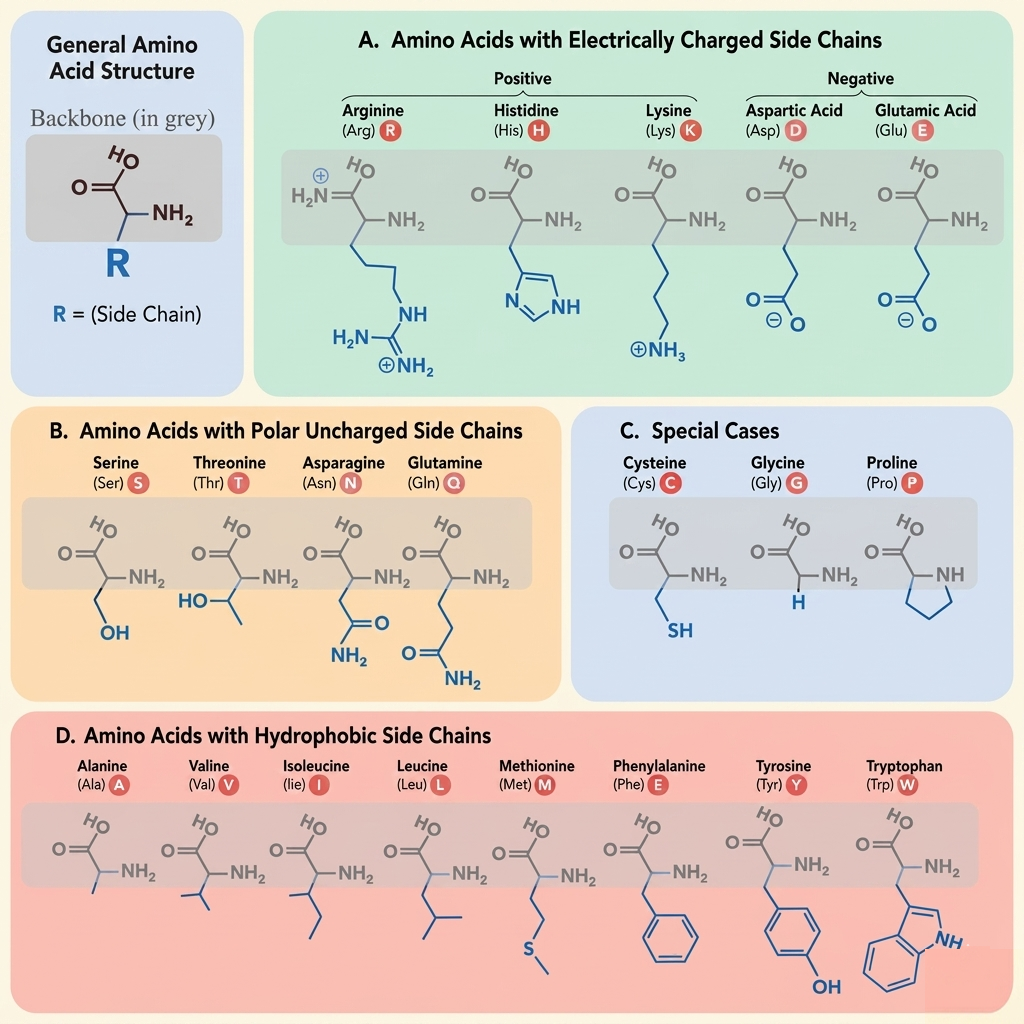
Every amino acid you need to know for the MCAT — structures, properties, pKa values, classifications, and high-yield facts. Organised by side chain type for rapid review.
mcatdoctor.com • Dr. Stuart Donnelly • The 20 Amino Acids for the MCAT
Amino Acid Guide — All 20 Structures
Backbone (grey): The NH₂–Cα–COOH core is the same for all 20 amino acids. Only the R group (side chain) differs.
At pH 7.4: The backbone amino group is protonated (NH₃⁺) and carboxyl is deprotonated (COO⁻). Charged side chains (Asp, Glu, Lys, Arg, His) carry additional charges.
All are L-amino acids: Proteins use only the L-enantiomer. All chiral except glycine (R = H). Most L-AAs are S-configuration, except L-cysteine which is R (sulfur's higher priority flips the CIP ranking).
Memorizing the 20 amino acids is a rite of passage for biochemistry and premed students. The most effective approach is to combine classification, mnemonics, and active recall like drawing.
1. Group by Chemical Properties
Instead of memorizing a list of 20, learn them in smaller, related groups:
Group
Amino Acids
Mnemonic
Nonpolar (9)
G, A, V, L, I, M, F, W, P
Grandma Always Visits London In May For Winston's Party
Polar Uncharged (6)
S, T, C, N, Q, Y
Santa's Team Crafts New Quilts Yearly
Acidic (–)
D, E
Dragons Eat
Basic (+)
K, R, H
Knights Riding Horses
2. The "Pirate & Dragon" One-Letter Codes
Most codes use the first letter (e.g., Valine = V), but these exceptions need tricks:
R = Arginine — "aRRRRginine" like a pirate
W = Tryptophan — "tWyptophan" (Elmer Fudd). Or: the double-ring looks like a W
F = Phenylalanine — starts with a "F-enyl" sound
N = Asparagine — "AsparagNe" — focus on the loud N
Q = Glutamine — "Q-tamine" — it's Quite like Glutamate but with an amide
K = Lysine — K is the letter right before L
D & E = Aspartate & Glutamate — Dragons Eat. D comes before E in the alphabet, just as Aspartate (smaller) comes before Glutamate (larger).
3. Master Structures Through "Logic Building"
Instead of memorizing every atom, learn how one structure builds into another:
G
Glycine R = H
+CH₃ →
A
Alanine R = –CH₃
+ring →
F
Phe R = –CH₂C₆H₅
+OH →
Y
Tyrosine R = –CH₂C₆H₄OH
4. Puns & Wordplay for Structures
Sometimes a goofy pun is stickier than a formal definition:
Cysteine Chapel — Picture two fingers (sulfur atoms) touching to form a disulfide bond, like the Sistine Chapel ceiling.
Leucine vs. Isoleucine — Leucine is the "L" shape. Isoleucine is the isomer where the methyl group moved.
Tyrosine (Y) — "Y did the tire get a flat?" Because it has a tire-shaped ring with an –OH hole.
Valine (V) — The branched –CH(CH₃)₂ side chain literally fans out in a V shape.
5. Essential Amino Acids (Must Come from Diet)
Use the classic mnemonic PVT TIM HALL: Phe, Val, Thr, Trp, Ile, Met, His, Arg*, Leu, Lys
*Arginine is conditionally essential
6. Mastering the Basic (Positively Charged) Amino Acids
Mnemonics: "His Lies Are Basic" (His, Lys, Arg). "HAL is Basic" (His, Arg, Lys). "Knights Riding Horses" — K, R, H codes.
Structures — look for N:Lys (K) — long "Line" ending in NH₃⁺. Arg (R) — 3 Nitrogens ("Nitrogen-Rich"). His (H) — House-shaped ring with 2 N.
Charge secret: Arg (pKaR 12.5) & Lys (pKaR 10.5) are always positive. His (pKaR ≈ 6.0) flip-flops — the MVP of enzyme active sites.
Pro-tip: Spend 15 min each morning drawing all 20 from memory. Within 5 days, muscle memory takes over. Combine with flash cards and the mnemonic groups above.
Found in protein interiors, membrane-spanning regions. Stabilise protein folding via hydrophobic interactions.
G
Glycine
Gly • MW 75 • pI 5.97
R = H. Only achiral amino acid — no stereocentre. Extremely flexible (no side chain steric hindrance). Common in collagen (every 3rd residue). Fits in tight turns.
A
Alanine
Ala • MW 89 • pI 6.01
R = –CH₃. Small, hydrophobic methyl group. Often used as the "generic" amino acid in examples. Very common in α-helices.
V
Valine
Val • MW 117 • pI 5.97 • Essential
R = –CH(CH₃)₂. Branched-chain amino acid (BCAA). β-branched — bulky at Cβ, destabilises α-helices.
L
Leucine
Leu • MW 131 • pI 5.98 • Essential
R = –CH₂CH(CH₃)₂. BCAA. Most abundant amino acid in proteins. Strong helix-former.
I
Isoleucine
Ile • MW 131 • pI 6.02 • Essential
R = –CH(CH₃)CH₂CH₃. BCAA, β-branched. Has two stereocentres (α-C and β-C).
P
Proline
Pro • MW 115 • pI 6.48
R = cyclic (side chain bonds back to N → imino acid). Rigid — introduces kinks/turns, breaks α-helices. Abundant in collagen. Cis-trans isomerisation at Pro peptide bonds.
F
Phenylalanine
Phe • MW 165 • pI 5.48 • Essential
R = –CH₂–C₆H₅ (benzyl). Aromatic, hydrophobic. UV absorption at 257 nm (weakest of the 3 aromatic AAs). Accumulates in PKU (phenylketonuria).
W
Tryptophan
Trp • MW 204 • pI 5.89 • Essential
R = indole ring. Largest amino acid. Aromatic — strongest UV absorption at 280 nm (used to measure protein concentration). Precursor to serotonin and melatonin.
M
Methionine
Met • MW 149 • pI 5.74 • Essential
R = –CH₂CH₂SCH₃. Contains sulfur (thioether, not reactive like Cys). Start codon (AUG) — first amino acid in every protein.
MCAT tip — Essential amino acids: PVT TIM HALL — Phe, Val, Thr, Trp, Ile, Met, His, Arg (conditionally), Leu, Lys. These cannot be synthesised by the body and must come from diet.
Found on protein surfaces. Participate in hydrogen bonding, enzyme active sites, post-translational modifications.
S
Serine
Ser • MW 105
R = –CH₂OH. Hydroxyl group — H-bond donor/acceptor. Site of phosphorylation (Ser/Thr/Tyr kinases). Found in enzyme active sites (serine proteases). Can be O-glycosylated.
pKa₁ 2.21 • pKa₂ 9.15 • pI 5.68
T
Threonine
Thr • MW 119
R = –CH(OH)CH₃. Hydroxyl group like Ser. β-branched. Has two stereocentres. Site of phosphorylation and O-glycosylation. Essential.
pKa₁ 2.11 • pKa₂ 9.62 • pI 5.87
N
Asparagine
Asn • MW 132
R = –CH₂CONH₂. Amide of aspartate. H-bond donor and acceptor. Site of N-linked glycosylation (Asn-X-Ser/Thr sequon). Cannot be charged.
pKa₁ 2.02 • pKa₂ 8.80 • pI 5.41
Q
Glutamine
Gln • MW 146
R = –CH₂CH₂CONH₂. Amide of glutamate. Major nitrogen carrier in blood (glutamine shuttle). Fuel for rapidly dividing cells (enterocytes, immune cells).
pKa₁ 2.17 • pKa₂ 9.13 • pI 5.65
Y
Tyrosine
Tyr • MW 181
R = –CH₂–C₆H₄–OH (phenol). Aromatic — UV absorption at 274 nm. The –OH can be phosphorylated (receptor tyrosine kinases). Precursor to thyroid hormones, dopamine, melanin. pKaR ≈ 10.1 (phenol OH, mostly protonated at pH 7.4).
pKa₁ 2.20 • pKa₂ 9.11 • pKaR 10.07 • pI 5.66
C
Cysteine
Cys • MW 121
R = –CH₂SH (thiol). Forms disulfide bonds (Cys–S–S–Cys) — covalent cross-links that stabilise protein tertiary/quaternary structure. The –SH is a nucleophile (active site of cysteine proteases). pKaR ≈ 8.3.
pKa₁ 1.96 • pKa₂ 10.28 • pKaR 8.18 • pI 5.07
MCAT tip — Phosphorylation targets: Only Ser, Thr, and Tyr can be phosphorylated (they have –OH groups). This is the most common post-translational modification tested on the MCAT.
Side chains are protonated (cationic) at physiological pH. Form salt bridges with negatively charged residues.
K
Lysine
Lys • MW 146
R = –(CH₂)₄NH₃⁺. Long flexible chain ending in ε-amino group (pKaR ≈ 10.5 → fully protonated at pH 7.4). Essential. Ubiquitination occurs on Lys. Acetylation of Lys on histones regulates gene expression.
pKa₁ 2.18 • pKa₂ 8.95 • pKaR 10.53 • pI 9.74
R
Arginine
Arg • MW 174
R = guanidinium group (pKaR ≈ 12.5 → always protonated at any biological pH). Most basic amino acid. Charge delocalised across 3 N atoms. Found in DNA-binding proteins (binds phosphate backbone). Conditionally essential.
pKa₁ 2.17 • pKa₂ 9.04 • pKaR 12.48 • pI 10.76
H
Histidine
His • MW 155
R = imidazole ring (pKaR ≈ 6.0). The only amino acid with pKa near physiological pH → can act as both proton donor and acceptor. Found in enzyme active sites (acid-base catalysis). Buffering capacity at pH ~6. Essential.
pKa₁ 1.82 • pKa₂ 9.17 • pKaR 6.00 • pI 7.59
Negative
Acidic / Negatively Charged at pH 7.4 (2)
Side chains are deprotonated (anionic) at physiological pH. Form salt bridges with positively charged residues.
D
Aspartate (Aspartic Acid)
Asp • MW 133
R = –CH₂COO⁻ (pKaR ≈ 3.65 → deprotonated at pH 7.4). Short side chain. Participates in salt bridges and enzyme catalysis. Transamination product: oxaloacetate.
pKa₁ 1.88 • pKa₂ 9.60 • pKaR 3.65 • pI 2.77
E
Glutamate (Glutamic Acid)
Glu • MW 147
R = –CH₂CH₂COO⁻ (pKaR ≈ 4.25 → deprotonated at pH 7.4). One CH₂ longer than Asp. Major excitatory neurotransmitter in the CNS. Transamination product: α-ketoglutarate. Key in nitrogen metabolism (glutamate dehydrogenase).
pKa₁ 2.19 • pKa₂ 9.67 • pKaR 4.25 • pI 3.22
MCAT tip — Calculating pI: For neutral AAs: pI = (pKa₁ + pKa₂) / 2. For acidic AAs (Asp, Glu): pI = (pKa₁ + pKaR) / 2. For basic AAs (Lys, Arg, His): pI = (pKa₂ + pKaR) / 2. Always average the two pKa values that flank the neutral (zwitterionic) form.
MCAT tip — Histidine is special: pKaR ≈ 6.0 means it's ~50% protonated at pH 6.0. At pH 7.4, it's mostly deprotonated (neutral). This makes His the best amino acid for acid-base catalysis in enzyme active sites — it can both donate and accept protons near physiological pH.